What is the max operating temperature?Updated 2 months ago
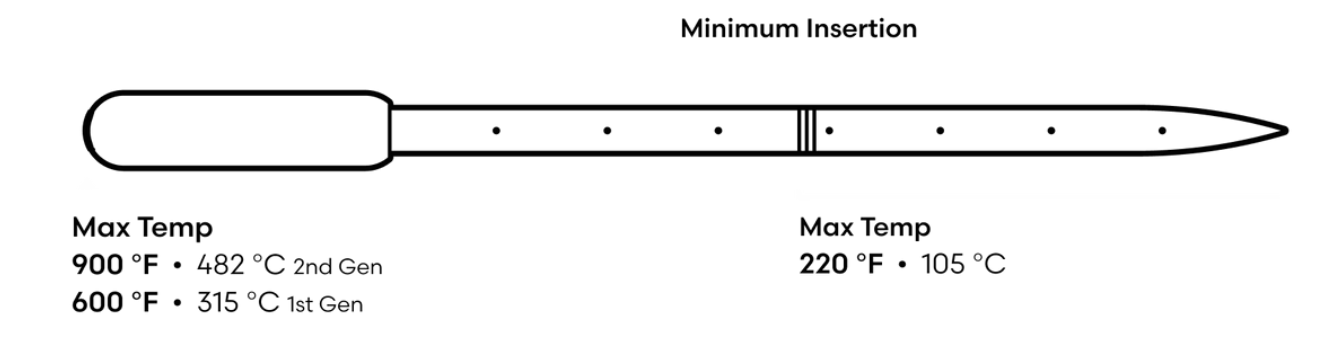
The thermometer has two zones with very different tolerances, and the minimum insertion line is the boundary between them.
| 1st-generation | 2nd-generation | |
| Below the insertion line (the tip, inside your food) | 220°F (105°C) | 220°F (105°C) |
| Above the insertion line (toward the ceramic handle) | 600°F (315°C) | 900°F (482°C) peak |
Always insert to at least the minimum line, about 2 inches (50 mm). It is clearly marked on the thermometer.
Two things worth knowing about the 2nd generation figure:
- 900°F is a peak, not a cruising speed. For sustained cooking, keep the upper half below 750°F (399°C). Brief excursions above that are survivable; long ones are not.
- If the ambient reading stops around 733°F (389°C), that is the sensor reaching the top of its range, not damage. See Warnings and Watchouts.
Why the tip limit is so much lower
It looks odd until you know the reason. The water inside your food cannot go above boiling while there is still water present, so the food itself keeps the tip cool. That is why the more delicate electronics and the battery live down there.
Your pork butt protects the probe, and the probe protects the pork butt.
It also explains the two situations where the tip is at risk: a pressure cooker, which raises the boiling point to about 248°F (120°C), and putting the thermometer directly into hot oil rather than into food.
Can I cook low and slow, near boiling?
Yes, and it is one of the things the thermometer is built for.
Slow cooking often holds meat just under boiling, frequently around 205°F, for hours. That is comfortably inside the tip's 220°F limit, and we have tested it extensively. We like pulled pork too.
A useful rule of thumb: 212°F (100°C) is an easy number to remember as a safety line. It is not the hard limit, but if you stay at or below boiling at the tip you have margin in hand.
The one thing to check is insertion. The minimum insertion line must be inside the food, not visible.
Is the battery safe at high temperatures?
Yes. The thermometer uses an LTO (Lithium Titanate Oxide) battery, which is considerably more stable than the lithium-ion and lithium polymer batteries in most consumer electronics.
LTO survives up to 105°C (221°F), and above that it simply fails rather than doing anything dramatic. Since it sits in the tip, inside your food, the water content keeps it below the boiling point in normal cooking.
Still have a question?
If you are planning a cook you are unsure about, email [email protected] and tell us what you are cooking, at what temperature, and in what. We would rather answer first than replace a thermometer afterwards.
[Related keywords: max temperature, maximum temperature, max operating temperature, temperature limit, how hot, how hot can it get, too hot, heat limit, 220, 105, 600, 315, 900, 482, 750, 733, upper limit, lower limit, tip limit, handle limit, insertion line, min line, minimum insertion, 50mm, 2 inches, low and slow, slow cooking, pulled pork, brisket, 205, near boiling, boiling, 212, battery, lto, lithium titanate, battery safe, battery high temperature, pressure cooker, oil, deep fry, searing, high heat, gen 1, gen 2, 1st generation, 2nd generation]